Brahms Plus

In the 1850s, Brahms was still questioning the form of the symphony and looking for a detour through the form of the serenade. The six-movement work was originally written for nine instruments; fortunately, this version could be reconstructed. Stravinsky’s Soldier’s Tale, from which the composer extracted three trio movements in 1919 for use in concert, is orchestrated in a much more sober manner. Just as Stravinsky’s music is inspired by the French poetry of Charles-Ferdinand Ramuz, composer Tatsiana Zelianko let herself be drawn to Envol by her own verses in French. In her poetry, she celebrates the transcendence of earthly heaviness and dreams of a state of serenity and lightness.
IGOR STRAVINSKY – Continuation of the Soldier’s Tale clarinet, violin, piano
TATSIANA ZELIANKO – Envol (Flight)flute, clarinet, tenor saxophone, piano, string quartet
JOHANNES BRAHMS – Serenade op. 11 original version of the creation in 1859 for nine instruments, flute, two clarinets, bassoon, horn, bassoon, violin, viola, cello, double bass
MARKUS BRÖNNIMANN flute
SÉBASTIEN DUGUET clarinets
MAX MAUSEN clarinet
DAVID SATTLER bassoon
LUISE ASCHENBRENNER horn
ANDREAS MADER tenor saxophone
SANDRINE CANTOREGGI violin
ISABEL VAN GRYSPERRE violin
SUSANNE MARTENS alto
ILIA LAPOREV cello
CHOUL-WON PYUN double bass
BEATRICE RAUCHS piano
MERCREDI
31|01|2023
19h30 Philharmonie Luxembourg, Salle de Musique de Chambre
 Plitsch, platsch! Mehr als hundert Jahre nach der einmaligen Aufführung des Musicals An der Schwemm (1922) der luxemburgischen Komponistin Lou Koster wird nun eine Adaption beim Festival de Wiltz aufgeführt. Der Schriftsteller und Journalist Batty Weber verfasste damals das Libretto in luxemburgischer Sprache. Inszeniert wird die Geschichte von Lory, einer selbstsicheren Schwimmerin, die im Schwimmbad den Avancen des Beamten Zengerlé widersteht und sich zugleich in den schönen Soldaten und Schwimmlehrer Reddy verliebt. Das Schwimmbad symbolisiert den Schmelztiegel des gesellschaftlichen Lebens der 1920er Jahre. Die Bühne gehört ganz und gar der Hauptfigur, die für ihre Freiheit wirbt.
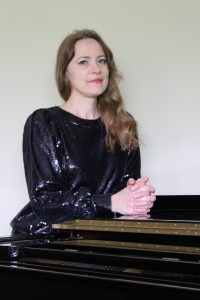 Belarus, she was trained at the Academy of Music in Minsk where she obtained a Master’s in instrumental performance (piano) and graduated as a piano teacher and chamber artist. She then worked at the Philharmonic of Brest, Belarus, as a concert pianist.After moving to Luxembourg in 2008, she turned to contemporary composition and began studying writing and musical analysis at the Conservatoire de la Ville de Luxembourg, of which she won two first prizes. In 2015, she won first prize in the Senior section at the International Composition Competition “Artistes en Herbes” in Luxembourg. A year later, Tatsiana Zelianko obtained governmental artist status in Luxembourg.She has to her credit several dozen of diverse and varied musical creations. The composer has already carried out a large number of musical commissions in Luxembourg in collaboration with Noise Watchers Unlimited, the CAPe, National Literature Center of Mersch, Ensemble Lucilin, Ars Musica, the CID | Fraen an Gender, the Philharmonie Luxembourg and the Ministry of Culture of Luxembourg.Her partitions have been created in other countries such as France, UK, Belarus and Bulgaria. Since 2013, her works have been included in the catalog of the “Luxembourg Music Publishers a. s. b. l.» bringing together Luxembourgish composers.In 2015, she carried out several State commissions, including one from the Philharmonie Luxembourg as part of the Rainy Days Festival in co-production with the Cinémathèque de la Ville de Luxembourg. The 90-minute work was composed for a cine-concert based on Alfred Hitchcock’s film The Lodger. Its world premiere was performed by United Instruments of Lucilin under the direction of David Reiland, on November 25, 2015 at the Philharmonie Luxembourg.